
Let’s start with Colin, as most people already know TikTok. He’s 80, and didn’t take up singing until his mid‑seventies. Somehow, I’ve ended up being his manager. I use the term loosely, as I’ve got no experience in talent management, and we fight like an old married couple.
The beginning was particularly fraught. We spent weeks in heated debate about the orientation of his videos. Before I arrived on the scene, Colin had already enjoyed some moderate success. His very first video, filmed by his gardener on an iPhone, had racked up more than 2,000 views on YouTube. People love that kind of thing — when somebody accidentally uploads their video sideways.
Eventually we found our rhythm. I film him in his home studio and do whatever finishing touches are needed before uploading to his YouTube channel. The process often involves giving him encouragement during those moments when his self‑doubt takes hold. We still bicker, but underneath there’s a genuine liking and respect. I’m fairly sure we both believe we’re managing each other.
Colin once was a manager. As the former owner of a successful car sales business, he still approaches things with an air of authority. Sometimes I tell myself I’m not going to argue, but my resolve never lasts. Once I even hung up on him. I can’t remember ever hanging up on anyone before. Twenty minutes later, when I rang back to apologise, we both found it very funny. He’s got a good voice, though definitely not in the calibre of Sinatra. He’s a natural showman, has the ability to make people smile, and looks pretty damn good for 80.
While I’m in town for a few months at a time, I head to his place once a week to record whatever song he’s been working on. On my last visit, I arrived to find a newly purchased smoke machine and a candelabra he’d moved indoors for our recording of Monster Mash.
This was followed by two weeks of muddled attempts as we worked out the best creative approach. Eventually we landed on me crouching down and panning in and out while holding the camera in one hand and operating the smoke machine with the other. Somehow, we created what we believed was our magnum opus.
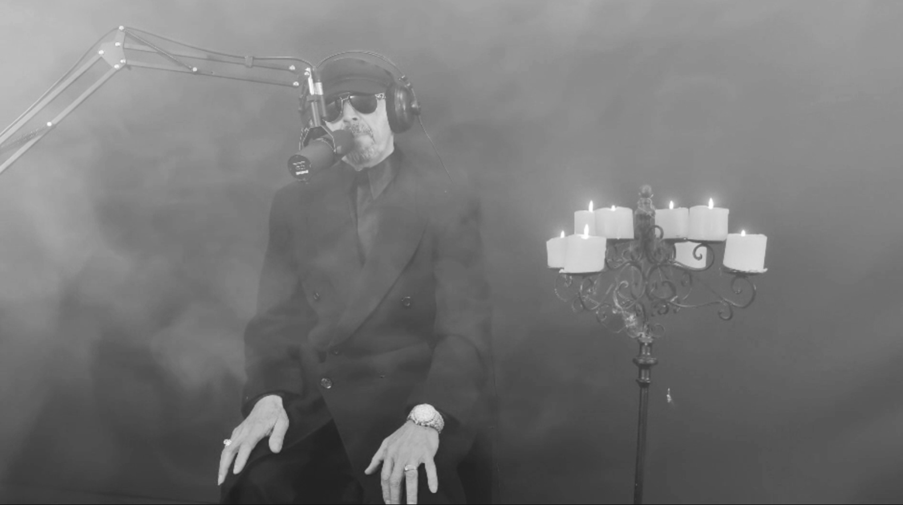
That brings us to TikTok — and a few more arguments. Colin knows a thing or two about marketing and I know a thing or two about algorithms. I’m not a fan of social media for myself, once being moved to write an entire piece about its pitfalls. But I’ve got nothing against trying to make Colin famous‑ish. Despite our disagreements, we’re both realists. And if I’m honest, I loved the idea of being involved in a social science experiment.
I was also curious to know whether I should hold the founder, Zhang Yiming, with the same level of disdain as I hold Musk and Zuckerberg, who have both been careless about the personal harm their platforms can cause and who use their power to try and avoid regulation. The jury’s still out, given that concerns about TikTok passing user data to the Chinese government haven’t been proven. What is clear, though, is that TikTok creates a very different kind of environment — one that feels less controlled and more chaotic.
With YouTube I’m likely only to see things I’m interested in, while TikTok feels more random. It’s an endless jumble sale of content, where you can find whatever your heart desires — or not. My For You feed flicks from a young person singing Sinatra beautifully, an older woman from New Zealand using f words and c words while ranting about a late penalty on her power bill, a segment from Stomp, a piece about starving children in Sudan asking for donations, and a compilation of people walking into glass doors.
Some of the content is reminiscent of the mid‑nineteenth century, when people went to the circus to see curiosities like the bearded lady. TikTok is full of people at every extreme you can think of — strikingly beautiful, impossibly thin or fat or short — often doing something that makes you stop for a second and, excuse the French, say WTF was that. Though unlike the days of the old sideshow acts, most of TikTok is uplifting, if often inane. There’s also the modern twist, where you stop and ask whether what you’re seeing is even real, or just AI.
This was the case when I came across Be Yourself Dylan. It turns out he is. Dylan lives with MDP syndrome, a rare condition that makes his skin smooth and gives his features an animated quality. He’s brave, fun‑loving, and his dance style — loose, expressive, completely himself — has helped him gain over 3 million followers. His message is simple: be yourself, be kind. Sadly, it doesn’t always get through A recent post announced that he was taking time out because of the mean comments.
And then there are the granfluencers — the many creators in their seventies and beyond with massive followings. Edwin is a 94‑year‑old who took up singing after his wife died in 2019 and now has over 1.4 million followers. His unaffected, pure voice brings innocence to the modern classics. Dorothea Taylor, the 75‑year‑old Godmother of Drumming, has 1.9 million. And the biggest granfluencer account belongs to Ross Smith and his grandmother, Pauline — better known as Gangster Granny — who together have nearly 25 million followers. She’s 100, pretty out there, and very funny. Like when she had a fan blowing on her face and her false teeth flew out.
More than any other platform, TikTok gives ordinary people a real chance to go viral. It’s full of everyday people, some of whom have become genuinely successful, making that seem within reach for everyone. As a result, the number of creators has ballooned, especially now with the rise of people using AI, and with it a growing number of people wanting to be noticed. Which brings us back to Colin.
Before posting our first video I did some research. It was advice for people like Colin and me, who despite our wishes are unlikely to be overnight successes. The most important thing is the first two or three seconds — the hook that stops people instantly swiping away. Then there’s video length and frequency. Keep them short. Most videos on TikTok are 15 to 30 seconds, the sweet spot for high completion rates. And post often — some recommend up to three times a day. Engage, follow, like. If you follow four thousand people and three and a half thousand follow you back, you’ll get more views and likes. Even at this early stage, I already know neither Colin nor I have the stomach for it.
I started with a few shorts of Colin singing and fooling around, just to test the waters. Each clip picked up a few hundred views, a handful of likes, the odd comment, even half a dozen followers. Then I uploaded a few Monster Mash shorts, and the view count progressively rose to over 400, with higher levels of engagement — likes, shares, saves. Not a momentous start, but enough to show that there are enough people out there who enjoy watching him to keep plugging away. But even those small wins made me realise how easy it is to start caring too much about numbers.
This brings me to one of the more sinister sides of TikTok. It’s full of people who become fixated on being noticed. Having a strategy that gives you the best chance of being seen is sensible, but not if it comes at the cost of authenticity. That’s when you stop being yourself and turn into a performing seal for the algorithm. TikTok exploits the human need for validation and can turn the pursuit of attention into something close to obsession. And that’s the sad part, as it stops being about connection and sharing a passion.
I guess one of the benefits of being an older user is having learned to take distance and not become fixated on outcomes. Though there will be plenty of young people have this wisdom too, and some older people who don’t. Within two days of posting the full Monster Mash it had picked up 698 views, 38 likes, 5 saves and 10 shares. A great start. And then, trying to practise some restraint, I put my phone in the next room for the night. When I checked it in the morning it had completely stalled.
I hear that on TikTok there’s always a chance for a promising video to be boosted again, sometimes months or even years later, and suddenly take off. In the meantime Colin keeps singing and practising because he likes singing. I help because I enjoy a challenge and like it, most of the time. We keep getting frustrated with each other, laughing when things don’t go to plan, and we keep plugging away, hoping that one day his music will find wider reach.