
My first meeting with Mary was as unique as the woman herself. I’d hopped off the train at Flinders Street Station, and as I rode up the packed escalator my attention was drawn to a brightly dressed figure up ahead who outshone even Melbourne’s most flamboyant commuters. What a great subject to photograph, I thought. But as I watched her disappear into the concourse, I let the idea go. I wasn’t in the mood that day for approaching strangers.
Then, standing at the main intersection in front of the station, waiting with the masses for the “cross now” symbol, I turned when someone beside me said, “Hasn’t Melbourne changed.” It was her — the woman in colour, a street photographer’s dream — and of course I wasn’t going to let the opportunity pass. When I told her I take street photos she was down for it without hesitation.
After crossing, we stopped so I could take her portrait. She posed as if on stage: shoulders back, chin lifted, a little flourish of the umbrella — click, click. She told me people call her Mary Poppins. I asked if I could also capture a story. We walked on until we came across a brightly coloured wall — a few more clicks, a few more theatrical gestures — and then on to a nearby café. In less than forty‑five minutes after hopping off the train, we were done. I left with what felt like a gift: photographs, a story, and the buzz of having met someone unique.
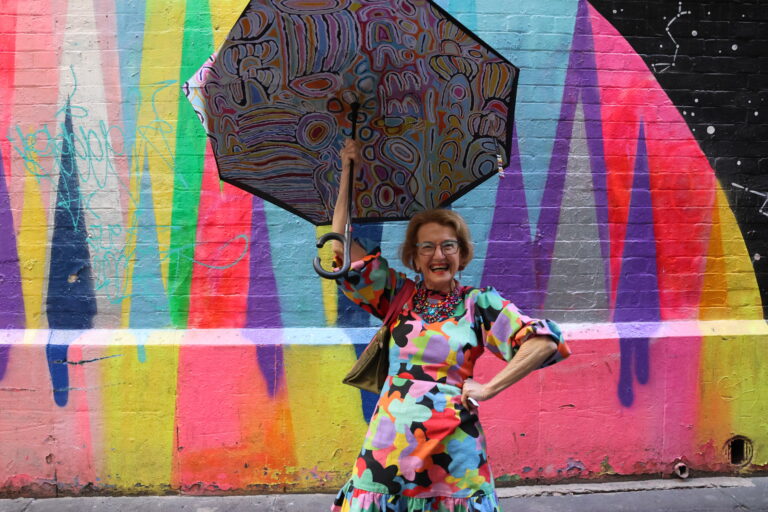
Our next meeting, over a year later, occurred with the same happenstance. I was staying at a place five minutes from her home, and of course I couldn’t miss the brightly dressed Mary when she appeared ahead of me on the street one day. Over the month I stayed there, I came to know more about her, and began to see that she and Mary Poppins have far more in common than carrying an umbrella wherever they go.
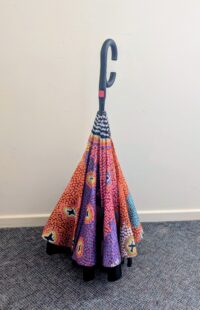
But let’s start with the umbrella. For both Marys it’s part of their identity — theatrical, expressive, and a sign of their willingness to be unapologetically themselves. It’s practical too. Mary Poppins used hers to travel from A to B like a flying carpet, and the real Mary uses hers for the rain and sun. It even has a stand, and wherever she goes she sets it beside her like a small companion.
Mary forgets her umbrellas, then buys a new one, leaving a trail behind her for unsuspecting beneficiaries. She doesn’t place value on possessions and owns very little beyond what she needs, and carries herself with the lightness of someone who has shed unnecessary possessions and the weight of her past.
Though she definitely doesn’t see the world through rose-coloured glasses. She doesn’t pretend things were easier than they were, doesn’t soften the truth to make herself look better, and rides the ups and downs of life with acceptance and grace.
Mary’s life is full of contradictions. She says she’s strongest when she’s most vulnerable, that you can be broken and still give to the world. She’ll quote the Bible and pray to Jesus, then point out she isn’t religious. And she talks about how much she loves people, even though it seems they haven’t always treated her well.
Mary tells me how she goes around “loving on people.” “I don’t say anything ugly; I just say love ya.” She recounts a moment from when her three boys were younger: I came home one day, flopped down on the couch depressed, and one of my boys said, “Mum, we heard you down the street.” Then he said, “But Mum, we know who you really are.” She tells this story with the same self‑awareness she’s gained over time, even though her boys seemed to see her clearly long before she did.
She often talks about the impact her parenting had on her children. One day she fled to the local church in bare feet, holding her eldest son, after her husband smashed up the house. “My kids were exposed to many things like that,” she says. “And my husband and I were as bad as each other.” She’s open with her adult children about all of it. She doesn’t defend herself or soften the past; she just tells the truth.
“My lows aren’t as bad as they used to be, but they’re still there. There’s a part of me that doesn’t add up to the story. But if it wasn’t there, I don’t think I’d be who I am today. I wouldn’t be sharing the love like this. There’s this person who hasn’t got it all together, even a bit of a loser. Then there’s this person who struts down the street in bright coloured clothes. And you know, if everything was perfect in my life, I wouldn’t be influencing anybody.”
One of her mottos is, “Get your eyes off yourself.” She says many people have got it all wrong — they think life is about getting rich, having a big house, having everything. “If you could see where I’ve come from, my life now doesn’t make any sense. Sometimes it’s about being a very broken person and finding strength in that.”
“I’m the weirdest person on God’s earth and I can’t help it. I don’t fit into society so it’s about saying to yourself, well, I’m going to make this work. And somehow it does. The more I’m down and the less I have, the more I’m spectacular. That’s when I see most clearly what matters.” She quotes a line from the Bible — “having nothing, and yet possessing everything. That’s me in a nutshell.”
“I’m an advocate for broken‑up people with broken‑down lives. They’re the ones who often do the most with their lives. They’re the ones closest to God.” Her life, she says, proves that if you’re on hard times, a bit of a weirdo, depressed, and doing everything upside down, you can still have the best life.
She hadn’t set out to live this way. “I know this sounds ridiculous, but somehow I’ve found myself to be a celebrity here, because everybody knows me. I’m not doing this on purpose, but everyone seems attracted to me because of how quirky I am. But the main reason they know me is because I’m loving on everybody.”
She jokes she’s like Mary Poppins, just a more broken, colourful version. “My life isn’t perfect but it’s miraculous. And now that I’m looking at me from a distance, I’m loving on that girl too. Yeah, I love her, and I wouldn’t want to change a thing.”