
Theoretical physicist David Bohm (1917–1992) came to my attention when I learned of his twenty‑five‑year collaboration with the spiritual philosopher Jiddu Krishnamurti. Though from very different worlds, they arrived at the same insight: that our suffering comes from inner fragmentation, and healing begins when we sense the underlying wholeness of life.
You’d think Bohm would be more widely known, given he was admired by figures such as Einstein, Oppenheimer, and the Dalai Lama. He was even nominated for a Nobel Prize in 1958. And some of his early ideas are now being picked up again in fields ranging from computing to neuroscience.
Yet much of the scientific community chose to ignore or reject him. It wasn’t that his work was disproved, but that he challenged the prevailing scientific framework and stepped beyond accepted boundaries. At the time, many scientists assumed the universe was fixed and fully knowable, rather than something deeper, creative, and unfolding.
And many of his peers saw his life-long struggles with mental health as a weakness in character. Yet his difficulties aren’t surprising when you consider the constant pressures he lived under — childhood trauma, political persecution, exile from the United States, professional marginalisation, and decades of feeling intellectually isolated.
Early Life and Academic Promise
Bohm’s fascination with space and imagined better worlds began in childhood, as a way of escaping the realities of his home life. His mother suffered from depression and bouts of psychosis, while his father was cold and dismissive, often treating the family harshly. Later, Bohm spoke of feeling “broken up inside.” These early experiences helped shape his lifelong desire to imagine and create a better world.
Other experiences deepened Bohm’s sense of injustice and his concern for the world’s problems. Growing up in the mining town of Wilkes-Barre, Pennsylvania, he saw his community fall into poverty during the Depression and decline further as coal was replaced by oil. He was also troubled by the history of his Jewish ancestry.
All of this fed his passion for learning and creating. From an early age, he immersed himself in reading and writing, especially science fiction, while also sketching out simple machines, electrical gadgets, homemade circuits and imagined technologies.
Despite dismissing these interests as impractical, his father paid for Bohm’s tuition at Pennsylvania State College. In the 1930s, physics was still a relatively marginal field in the United States, giving Bohm freedom to pursue independent study. His intensity and originality soon stood out, leading to doctoral work at Berkeley under J. Robert Oppenheimer. As his work attracted attention, those around him believed he was on the verge of making significant contributions.
Political Pressure and Exile
However, the promise of Bohm’s career was disrupted by a series of significant setbacks beginning in his early thirties. Under growing political pressure and fearing for his position, his mentor Oppenheimer distanced himself from Bohm as his work increasingly challenged established assumptions in physics. Oppenheimer’s withdrawal left Bohm feeling abandoned. He became depressed and contemplated suicide.
Soon after, Bohm became entangled in the McCarthy investigations. He was arrested, put on trial and after refusing to testify against colleagues, effectively exiled from the United States. The loss of his home, community, and professional standing was abrupt and devastating. In Brazil he struggled with isolation and financial insecurity. When he later moved to Israel, he met Saral who helped him find some stability. Yet he continued to face professional marginalisation there, and later in England.
Collaboration with Krishnamurti
Bohm first encountered Krishnamurti when he was forty‑two. Saral, now his wife, had found one of Krishnamurti’s books in the library and, thinking it might interest him, brought it home. Bohm resonated deeply with Krishnamurti’s views on wholeness and unity.
A few months after discovering Krishnamurti’s work, Bohm met him at a talk in London. Both men believed that societal change begins with the individual. When the mind is caught in inner disturbance — confusion, pressure, and conflict — the world we create mirrors that. But when a person begins to understand the movement of their own mind and senses the deeper unity beneath it, their way of living naturally shifts.
Meeting Krishnamurti offered Bohm a bridge between science and the spiritual, giving him a sense that real change was possible. Yet Bohm continued to struggle with his mental health during their many years of collaboration. Krishnamurti’s emphasis on inner transformation without outside guidance may have kept him from seeking help earlier.
Over the years pressures were building around him. His relationship with Saral had become strained, as she also struggled with her mental health. He was increasingly questioning Krishnamurti’s authenticity, sensing a divide between certain teachings and aspects of his personal life. And even though Krishnamurti rejected the role of a guru, many around him treated him as one and worked hard to preserve that image. Added to this were his growing concerns about the way the Krishnamurti schools and educational centres—institutions to which he had devoted years of his life—were being managed.
These concerns that he never aired publically, along with his inner turmoil, left him disillusioned. As Bohm became increasingly unwell, Krishnamurti stepped back from the relationship saying he ‘can’t have learnt anything’. This withdrawal hurt Bohm deeply and he fell into a further decline.1
Final Years
The last fews years Bohm’s life says a great deal about him. Even as he suffered, he still achieved an incredible amount. In between periods of collapse and despair, he kept working, kept thinking, and kept reaching for coherence, even as his body and mood were failing him.
As Bohm’s condition worsened, he was hospitalised. When he was well enough to be released, he began group sessions with a Freudian analyst. This stood against Krishnamurti’s teachings that psychological clarity arises from direct observation, not analysis. Yet Bohm found the sessions helpful. They slowed his racing thoughts and opened new ways of thinking about consciousness
He tried to bring these insights into his own work, believing that shared thought shapes consciousness at the level of neurons. For him, dialogue wasn’t debate but a way to heal fragmentation. It is a space where collective attention can steady the mind and soften the patterns that keep people divided. This gave him a renewed sense of direction, and he soon set up his own dialogue groups, which continued long after his death.
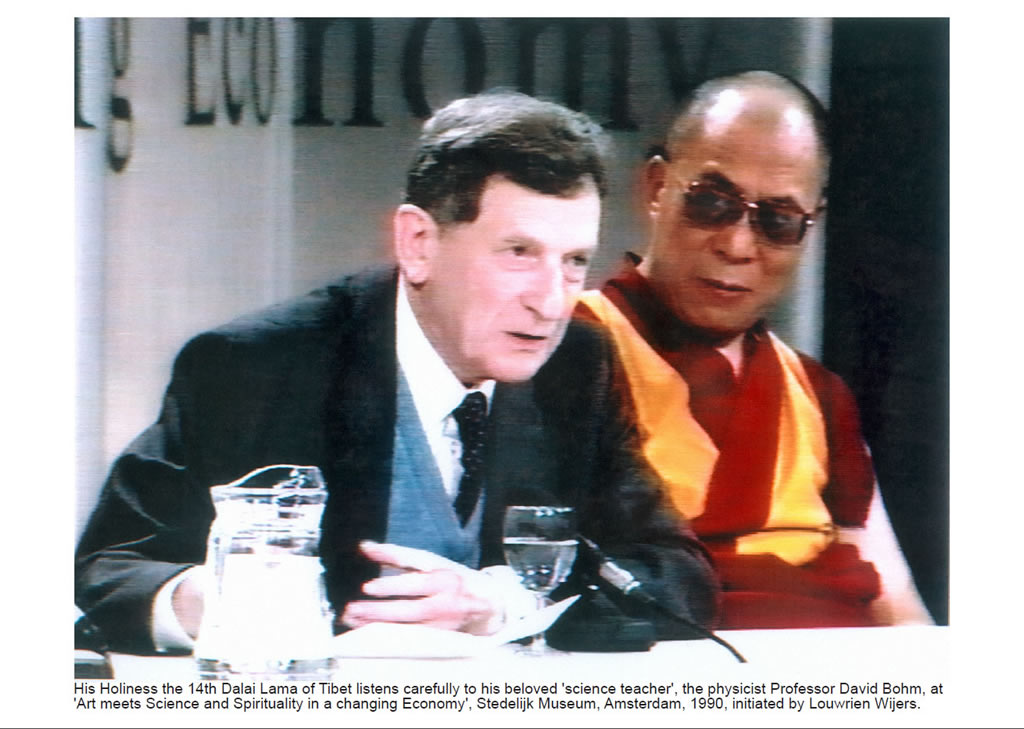
During this period Bohm also spent time with the Dalai Lama, who came to call him his “science guru.” Their conversations were especially fruitful when they turned to the nature of the universe. Bohm had reservations about the Big Bang picture—not necessarily rejecting it, but questioning whether reality could really be understood as beginning with a single event. The idea of a universe continuously unfolding seemed more compatible with his deeper sense of reality.
But even with these moments of clarity, Bohm’s health, already fragile since the 1970s, deteriorated further. His energy was low, and he fell once again into severe depression, expressing doubts that his work had meant anything at all. He was admitted into psychiatric care again, where he underwent fourteen bilateral ECT treatments, which calmed him and led to his release.
Though Bohm was troubled by his loss of memory and ongoing lack of energy, there were still moments of real uplift before his death around a year later. He participated in dialogues with Western scientists and Native American elders who welcomed him with unusual warmth and treated him as a distinguished elder. This experience seemed to steady him at a time when he felt depleted and unsure of himself.
Bohm died of a heart attack in 1992, aged seventy‑four. His last words to Saral were, “You know, it’s tantalizing. I feel I’m on the edge of something.”

Legacy
In his dialogues with Krishnamurti about healing, Bohm spoke often about the brain, returning again and again to the idea that it becomes fragmented by trauma and conditioning. He also spoke of the mind–body connection, and could see how the trajectory of his life had shaped his mental and physical health. Yet he grappled with how little science could tell us about these impacts and also what to do about them. He turned the suffering that shaped him into a gift for the world, though at a huge personal cost, as he never found ways to ease it.
Today we know far more. Research shows that significant trauma can affect the whole body, dysregulating the nervous system and contributing to conditions such as depression and chronic illness when such experiences remain unresolved. We also know that healing often involves learning to regulate the nervous system, creating the conditions for the body and mind to recover. There are many books on healing that try to bridge science and spirituality, and speak to the sense of wholeness he spent his life seeking.
The very things Bohm struggled with now inform a wide range of fields. His ideas on fragmentation, and his insistence that thought and feeling are inseparable, sit at the centre of disciplines from trauma studies to body-based therapies. Practices that might have supported his own healing had he lived to see them. As researchers across physics and neuroscience continue to explore the questions he dedicated his life to, his work is finding its place.
You can read more about Krishnamurti’s life here
1 Peat, F. D. (1996). Infinite potential: The life and times of David Bohm. Addison-Wesley.